Joanne Stuart and Nick Carter’s relationship
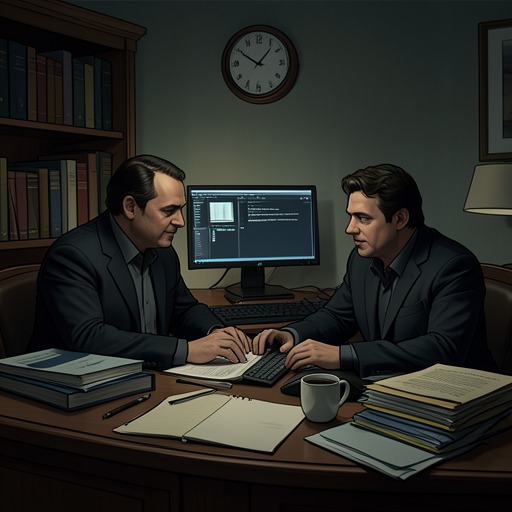
Blow OutJoanne Stuart and Nick Carter’s relationship is a close working partnership shaped by mutual trust, directness, and the strain of a high-stakes investigation. As Joanne takes the lead on Operation Alecto, Nick supports her decisions and challenges them when needed; their easy banter does not erase the professional hierarchy between them, but helps them work through its tensions while they pursue Darren Clements and try to protect his possible next targets.
Professional Trust and Shared Method
Their partnership is grounded in a common investigative discipline: separating suspicion from proof. When forensic and CCTV findings point toward Darren Clements, Nick calls him the likely offender, but Joanne immediately distinguishes that belief from what they can establish in court. She also insists that the connection between the victims and her sister’s death remains unproven. The exchange captures their complementary instincts: Nick recognizes a compelling pattern, while Joanne keeps the evidential threshold and the investigation’s limitations in view.
Joanne turns that caution into a practical plan. She directs searches of live and historical ANPR records, nearby passive-media footage, and possible parking locations around Clements’s home, and orders continuous surveillance. Nick is involved in the same process, and when the pair later discuss how to find Clements, he emphasizes the importance of collecting CCTV and witness information about any vehicle he may have used. Their work is not simply a matter of identifying a suspect; they have to locate him and establish a reliable chain of evidence.
The partnership also depends on frank questions. While returning from an unsuccessful inquiry, Carly Whittle asks Joanne why she did not take a rifle for forensic comparison. Joanne answers that she lacked a warrant, explains why pellet marks were unlikely to produce a courtroom-quality match, and acknowledges that she could have asked for voluntary consent. Nick receives her report of the day’s events and recognizes that the visit has eliminated a significant person of interest, even if it has cost the team time. This emphasis on scrutiny reflects the way Joanne and Nick work together: they assess both what an investigative lead suggests and what it can actually prove.
Complementary Judgment Under Pressure
The investigation’s uncertainties are present from its earliest stages. After a doctor explains that the exact nature and quantity of the toxin are unknown, and therefore that the possibility of saving the victim cannot be determined, Nick notes how many possible perpetrators might exist in Manchester and beyond. His comment registers the scale of the problem rather than claiming a solution. The case begins with a wide field of possible suspects, and the partners must gradually narrow it through evidence.
Later, the possible vehicle connection gives that work a sharper direction. Nick identifies the Nissan Micra as a likely link to Clements, while Joanne points out that the suspect’s motive and the car’s appearances near crime scenes still fall short of proof. When Joanne worries that alerting Clements may cause him to accelerate his attacks, Nick argues that urgency could make him more visible and more likely to make mistakes. Joanne refuses to let that possibility soften the immediate danger: they must identify and warn any remaining targets. Their different emphases—Nick’s attention to investigative opportunity and Joanne’s focus on the lives at risk—combine into a shared response.
Their exchanges also show how they manage pressure through humor and candor. When Nick sees Joanne after she has rushed back to the team, he remarks on how exhausted she looks and then checks whether she is all right. During a later moment of tension, Joanne says she needs him to raise her spirits rather than dampen them. The teasing is familiar, but it serves a practical purpose: it lets them name strain without withdrawing from the work or pretending that the pressure is absent.
Authority, Care, and Friction
Joanne’s promotion to Detective Inspector and her appointment to lead Operation Alecto create an imbalance that she knows can affect Nick. She suspects that he is still smarting because she became a DI first and was placed over him to lead the operation. Although she tries not to treat him like a junior, she recognizes that pressure and physical fatigue make it easier to slip into that mode. This self-awareness establishes that their closeness does not make the hierarchy disappear; it makes the consequences of that hierarchy something Joanne must actively manage.
Nick’s loyalty is visible in small, concrete acts. When Joanne returns, he has stayed at work rather than following her instruction to go home, and he explains that he managed a short rest in the conference room. He has also continued examining evidence, handing her a blue hard-backed notebook from the lock-up in an evidence bag and indicating the relevant page. His decision to remain is not presented as a breach that changes their partnership; it is evidence of his commitment to the case and his judgment that there is still work to do.
Joanne responds with concern and familiarity, asking whether he went home and then noticing that he needs a shower and a shave. The exchange reverses the more formal pattern of supervisor giving direction and subordinate receiving it: Nick has disregarded an instruction, but his initiative has yielded an important piece of evidence, while Joanne’s irritation is tempered by her reliance on him. Their relationship is sustained by this combination of authority, practical dependence, and personal regard.
Shared Responsibility and Consequence
The notebook’s importance coincides with Joanne’s awareness that the team’s focus may have narrowed too much around finding Clements. She recognizes that if he has been working through a list of people he blames for his sister’s death, there may be further names on it. Nick suggests that being rushed could make Clements careless; Joanne answers by returning to the potential victims, insisting that their lives depend on the team identifying and warning them. Their partnership thus moves from reconstructing the offender’s movements to anticipating what he may do next.
After Clements dies during the police operation, professional review and personal consequence converge. Joanne is haunted by his expression in the moments before his death and recalls that he had been trying to escape, not to put himself in danger. The distinction does not undo the outcome; it deepens her distress. Nick and the rest of the team are present in the aftermath, but the evidence here leaves Joanne’s private burden foremost. The partnership has carried them through the operation, yet shared work cannot simply divide or remove the emotional cost of its ending.
Narrative Significance
Joanne and Nick’s relationship gives the investigation a human structure as well as a procedural one. Their exchanges repeatedly test the balance between suspicion and proof, command and collaboration, urgency and care. Nick can recognize a pattern or an opportunity; Joanne can insist on the evidential and human consequences of acting on it. Neither role is absolute: Nick questions, supports, and contributes evidence, while Joanne acknowledges uncertainty and the ways her authority can affect him.
The ordinary details of their working life—the missed rest, the evidence bag, a pointed joke, an instruction that goes unheeded—make the partnership credible without turning it into sentimentality. They remain colleagues under pressure, not a relationship free of friction. Their trust is shown through continued cooperation: they can disagree about what a clue means, return to the same task, and keep the investigation’s obligations to both evidence and endangered people in view.